
Are you often looking to find out how you can get more traffic to your blog?
If you have, it’s likely that you’ve browsed many posts that confess to having the secret formula and many of them might work. But I want to suggest a blogging tactic that you probably haven’t read about and which could be the best way to increase your organic traffic!
HubSpot calls it ‘The blogging tactic no one is talking about’.
Relaunching your old blog posts
If you’ve had your blog for a couple of years, you’ll have realised that some posts simply get traction and others don’t. That’s common. But your next step is what I want to talk about.
Typically, we cop it on the chin if some of our posts flatline and just move on to creating our next one. Is this what you do?
If it is, you’re leaving your blog with a range of posts that simply don’t rank and don’t drive any traffic. And if you understand the concept of ‘crawl equity’, then your SEO strategy isn’t performing for you as it should.
But, maybe one reason your blog posts aren’t performing well is that they’re unhelpful to the site visitor. Google rolled out its Helpful Content Update (HCU) from August through September 2022. This update, along with Google’s content guidelines, can help you determine whether to improve and republish or remove an old blog post.
Google’s new helpful content update: 2022
Before we get to the how of relaunching blog posts, let’s determine whether you should relaunch old blog posts. First, understanding Google’s HCU is critical to your content strategy.
But before HCU, Google had already stressed the importance of high-quality, expert-led content, otherwise known as the E-A-T guidelines. Short for expertise, authority, and trust, writing with EAT in mind means you are providing your site visitor with credible information and a satisfying site visit.
The HCU helps Google determine what is helpful to the user vs. what is not helpful to the user. For example, an article that is stuffed with keywords and doesn’t answer related questions that the user might have is not very helpful.
Google will “reward content where visitors feel they’ve had a satisfying experience, while content that doesn’t meet a visitor’s expectations won’t perform well.”
The HCU is a site-wide signal, which means if Google feels that your site has a majority of unhelpful blog posts, then your site will be classified as unhelpful. Consequently, you might see your site ranking go down.
What is unhelpful content?
Unhelpful content is information that provides little to no value to the site visitor.
- Repeats information from other sites on a similar topic
- Search-engine first blog posts
- Automated content
- Unnatural language or poorly written content
- Content that is clearly written by someone who is not an expert, but someone who is trying to gain traffic to their site
- Content that does not provide visitors with an answer to their question(s)
- Content that does not serve your existing audience
- Content in random industries/topics written to gain traffic to site
What is helpful content?
In short, helpful content is one that emphasizes authenticity and the user experience.
- Provides a unique point of view where applicable (e.g. Product or service reviews)
- Provides authoritative, expert-led, trustworthy information
- Answers the site visitor’s questions and more (Positive site experience)
- Human-first approach
- Natural language
- Content catalog with a primary focus or purpose
- Content that is created for target audience
- Content that adds value to what is already available on the internet
Which industries will likely be most affected by the HCU?
According to Google, content in these areas will be most impacted.
- Educational materials
- Arts and entertainment
- Shopping
- Tech
In the affiliate marketing niche, Google’s HCU and product reviews updates also help reduce inauthentic, duplicate content.
How is relaunching old blog posts going to increase organic traffic to my blog?
You might not go back over all of them (though you should if you have the resources), but you should at least have a look and identify if some can and are worth being revived.
The chances are that you likely fell into the trap of pumping out blog posts more frequently than you should have because you were told ‘Google loves fresh content’.
This is true–Google did note in late 2011 that they were implementing a freshness factor to their algorithm, but this was largely (in my opinion) taken out of context. Bloggers (and businesses) started publishing more and more often with more focus on quantity than quality.
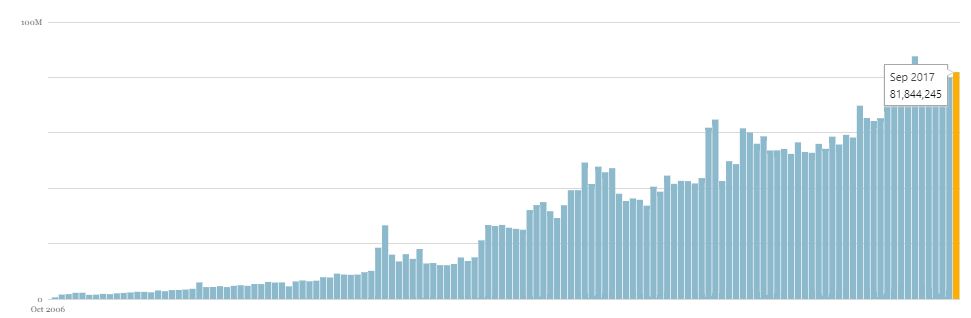
That trend has made it more difficult to get your content seen. It also presents a huge problem for the searcher trying to wade through posts that don’t help them find what they need, which is a core issue Google is trying to fix with the HCU.
I like this one from Convince&Convert:
“As consumer comfort-level with information overload increases, so does their demand for high-quality content. Modern consumers are self-educating, and they’re adept with finding the information they need via the internet. In order to build a strong platform for your brand, your content will need to enable the self-starting consumer to conduct in-depth research all on their own.”
So, if you look back on those old posts of yours, ask yourself some key questions.
- Are they quality posts?
- Do they provide value to the reader?
- If I was searching for this topic, would this post satisfy me?
- Does this blog post provide helpful answers to questions my audience might have, and not because it uses a trending keyword that I hoped would attract more traffic?
If you answered ‘no’ to any of those questions, then it might be worth improving and relaunching these old posts.
And if you need any more reason to improve old posts, how about ranking for featured snippets…
SEMrush suggests that if you want to rank for featured snippets, then you should ‘re-optimise your best old content that ranks in the top 10, but lacks featured snippets‘.
Here’s a checklist by SEMrush for your old posts:
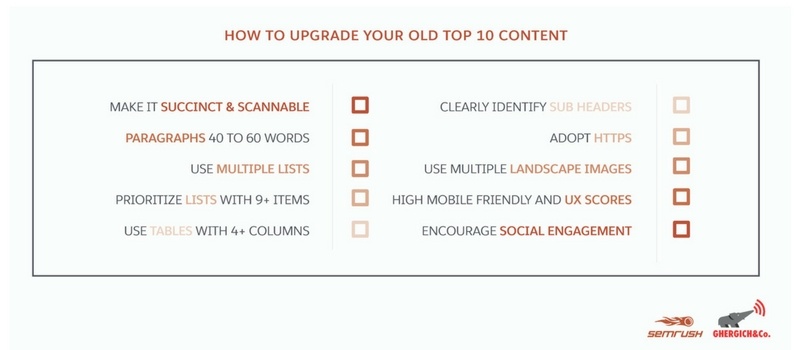
Since Google published its freshness factor in 2011, they have released other guidelines and updates to its algorithm. It’s not just fresh content that will help your site rank, but other signals like helpful content, E-A-T writing guidelines, and high-quality links.
Should I 404 a page or noindex it?
There is little value in no-indexing a page that is neither helpful to your visitors nor to your site ranking. For unhelpful blog posts, the best move may be to delete them, especially if they are not contributing much to your domain ranking.
So what posts should I relaunch?
Jump into your Google Analytics account. You’re going to need it to identify your content’s search volume and conversion rate. Try to classify each of your blog posts into one of the following four categories.
1. High Traffic/ High Conversions
It’s likely that these posts don’t need to be relaunched (optimised).
2. High Traffic/ Low Conversions
Why aren’t these posts converting? Depending on your objectives, have you placed prominent call-to-actions in them? It might be the case that the traffic is not spending enough time on the page (check your analytics) to see the CTAs. If that’s the case, you need to work on your headline and opening paragraphs.
But, it may be the case that your content for these posts is just not strong enough to encourage your readers to take action. There may be an opportunity to provide additional value and even to ‘social proof’ them so that people will be more likely to act.
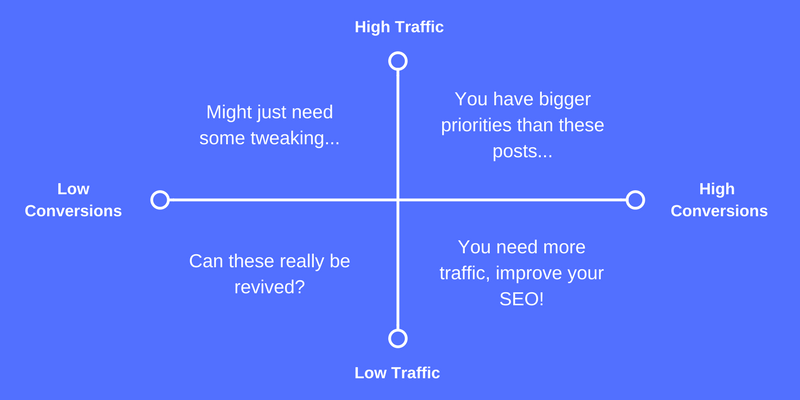
3. Low Traffic/ High Conversions
If you’re low on traffic, then it’s likely that you need to improve your search visibility. There’s definitely a need to look at how these posts are addressing the searcher’s intent and ensuring that you’re answering their queries. You also need to look at optimising these posts and spend plenty of time promoting them all over again.
Start by identifying your posts that are ranked anywhere between 10 – 20 for the relevant search terms. This demonstrates that these posts are on Google’s radar but simply aren’t strong enough to break into the top 10 sources.
If any of your posts are ranking higher than 30, there may be bigger issues, and your task may really be ahead of you for those items.
4. Low Traffic/ Low Conversions
Can these posts be optimised? What are their issues? Are they targeting topics that no one is searching for? If that’s the most probable reason, then you’re not likely to change that behaviour.
Think about deleting these posts and redirecting the links to better-performing (but relevant) posts. If there is enough search traffic for the queries, then you may have something to work with, but it’s going to take some effort.
What should I do to relaunch my blog posts?
1. CREATE MORE VALUE FOR THE READER
This is obviously the focal point of the whole process. So, you need to do your due diligence here.
First, identify the topic you want to address. It should be one that will attract traffic to ultimately help you achieve your objectives. Understand the range of queries that your target audience has around this topic, and target trending keywords that are relevant to your audience.
TIP: Use lsigraph.com or answerthepublic.com to get some ideas around the search queries that are related to your specific topic. You can also go a step further and start testing these search terms with Google’s Keyword Planner to identify high-volume searches.
You now need to understand how well your existing post is answering these main search queries. Fill in any content gaps to ensure you’re providing a comprehensive resource. If you can support your content with images or videos, then do it. Your aim in many instances (whether it’s achievable or not) is to provide visitors with ‘the most valuable resource on the web’.
Google’s HCU values content that has information or perspectives that are not available online already. Depending on your industry, this might mean contacting an expert for an interview or allowing an expert to guest post on your blog instead of trying to write about a complex topic.
Could your post be repurposed? The Mention blog has some great tips on this very topic. Creating an infographic is certainly one option. People love them (and share them). Visme has a great resource on how to make an infographic.
CASE STUDY: HubSpot conducted a study of their own blog back in 2015 and had some interesting findings on longer-form content, including:
– Articles with a word count between 2,250 and 2,500 words earned the most organic traffic.
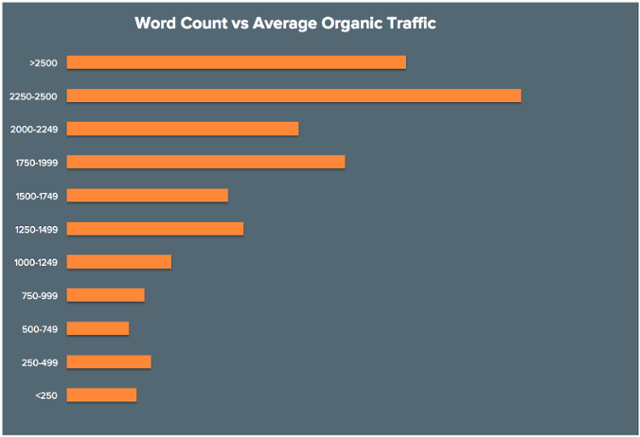
Source: Hubspot Blog
– Articles with a word count of over 2,500 were shared the most on social media.
– Articles with a word count of over 2,500 earned the most links.
It’s helpful to note that Google has stated they don’t have a preferred word count, however. It is more important to ensure that your content is top-tier than to write non-value added content to reach a certain word count.
2. RE-SEO THAT POST
Was your post optimised for search engines when it was first published? Was your post written for search engines when it was first published?
Whether your answers to these are a ‘yes’ or a ‘no’, you need to look at your blog post again. If you’ve changed your keyword/topic focus, then your optimisation will need some tweaking.
If the blog in question is clearly written to appease search engines and does not provide a great user experience for your site visitor, it’s time to rewrite that piece.
What is your target keyword?
Search for it in Google. Scroll to the bottom of the search result page and check out some of the ‘Searches related to…’ listings. These are related search terms that Google has identified, otherwise known as long-tail keywords. Try to implement them into your post if and where appropriate.
Is your post broken down with sub-headings?
Doing this will make it more ‘snackable’ and easier for people to read. But with the SEO hat on, it also gives you an opportunity to inject some important keyword terms into those sub-headings.
Ideally, they should be implemented with h2 tags. If you’ve got sub-sub-headings, then use h3 tags. The tags help to demonstrate a hierarchy and make it easy for someone to skim through the blog post for pertinent information.
Improve your internal linking
Do you have higher-authority pages on your site that could naturally link to the blog post? Start with your home page.
You may have relevant service pages, and you’re likely to have other blog posts that could link naturally. Improving your internal links is one of SEO’s easiest wins.
Look at your heading. Is it compelling?
Your heading might be all that a potential reader sees, whether it be in their social news feed or in Google’s search results. If it doesn’t get their attention and encourage them to click, then you’ve lost an opportunity.
TIP: Check out CoSchedule’s Headline Analyzer. Start testing a whole range of blog post titles to get an optimal score. Aim for 60+.
Here’s a range of other SEO tips to ensure you’re giving your post that extra boost.
- Link to authoritative sites where appropriate.
- Link to other relevant pages on your post (and vice-versa).
- Got images? Make sure they have relevant and keyword-related file names, title, and alt tags. Make sure they also are the right size and are compressed.
- Look at your meta title and description. Do they both still reflect your newly updated post? Can you make them more compelling in search results?
- Use infographics to convey complex ideas and data.
Do you use AI-generated content?
Many agencies and companies use AI-generated content to scale up their publishing schedule. The problem with this is that no software is perfect, and your reader (and Google) can likely tell that your blog post was not written by a human.
If there is no other option but to use AI for your articles, at least edit them to add more value, correct mistakes, and improve the language before publishing it to your site.
Google is cracking down on poorly-written content, which is often found on sites that generate revenue through affiliate marketing and ads.
3. RE-PUBLISH AND RE-PROMOTE
The first benefit you’re going to see when you re-publish your post with today’s date is that it will go to the top of your blog feed. It will get more attention and more clicks.
You then need to re-share it on your social media profiles. You probably did this when it was first published but what you may not have done back then was share it more than once.
Won’t that be pestering my followers? A little spammy?
You’re not going to repeat the same post. Check out this formula to give you a guide.
And why go to this extra effort you might ask?
To answer this, we should look at how long your posts are expected to last on social media. Here’s what The Refinery published on their blog:
Twitter: 18 minutes
Facebook: 5 hours
Instagram: 21 hours
LinkedIn: 24 hours
Pinterest: 4 months
Blog post: 2 years
YouTube: 20 days or more
If Twitter is part of your content distribution, then you have only 18 minutes! Can you get it in front of enough eyeballs? Or the right eyeballs in that timeframe? And when is the best 18 minutes to have your post visible?
Make the most of your social following, and get the reach you deserve. Work on the above formula and share your posts more than once.
Besides social media, there are also many, many more opportunities to re-promote your freshly updated and improved blog post. Most likely on platforms that you didn’t use when you first published.
Check out these sites:
– Medium
– LinkedIn Pulse
– Business2Community
– Reddit (Share it and also link to it in ‘Answers’ on the topic)
– Quora (Publish it and also link to it in ‘Answers’ on the topic)
And no, this doesn’t mean you’ll have duplicate content. Each of the above sites will point back to yours, ensuring you get credit. Besides, Google will have already crawled the post on your site and have it attributed to you anyway.
What results can I expect?
If there’s one certainty, it’s that there’s no certainty. With Google likely being your website’s key traffic source, we can’t guarantee anything.
But picture what Google will identify when they start crawling a relaunched blog post after you go through this optimising process:
– They’ll see an updated post with more content, covering more related topic queries.
– They’ll see a post that’s getting more traffic from social media and other websites.
– They’ll see fewer people coming from Google and then doubling back (pogo-sticking).
– They’ll see people spending more time on your page.
It’s certainly not a stretch to say that you SHOULD expect a boost in your organic traffic.
But go and test it for yourself. And if you need some more proof, check out both HubSpot’s and Backlinko’s results.
If Google classifies your site as unhelpful (and lowers your ranking), this classification can take months to reverse or improve. However, if Google sees that you are making long-term efforts to make your content more helpful, then it will reward your site with more visibility.
Seriously, your old posts are potential treasure troves of organic traffic and leads. Even for our own blog, three posts (each between 3 and 6 years old) drive 60% of our daily traffic. We consistently monitor them to ensure they remain relevant and deliver on our searcher’s intent.
This is really what the Google algorithm is looking for–at least, in our opinion. Use these strategies to help inform your content strategy moving forward, and remember that Google’s guidelines are ever-changing, but helpful content will always be relevant.