
For the e-commerce manager or marketer, there are a lot of distractions in growing organic traffic. There are also a lot of opportunities.
One of the keys to success is knowing the difference.
It’s important to remember the crucial role of organic search and e-commerce SEO.
SEMrush conducted a study and identified that 37.5% of traffic to leading e-commerce websites comes from organic search.
If you want to get more traffic and sales from organic search, then this SEO checklist for ecommerce will be a valuable resource.
User Experience (UX)
To the e-commerce manager, UX is always going to be a priority. But to others, it has always been vulnerable to a trade-off with the SEO guys. However, great UX improves the likelihood that the searcher will accomplish their task. Hence, UX is a hot SEO topic and is widely considered to be an influencing factor.
Here’s what you can do to create a great user experience:
1. Make sure your site is mobile-friendly
Presenting your user with a mobile-friendly website is a no-brainer. The majority of your orders might get attributed to desktop users, but you need to understand that a lot of them will have started their experience on their mobile. Disappoint them there, and you lose a sale.
Check your mobile-friendly credentials with Google’s ‘mobile-friendly‘ test. You don’t need to test every page on your site, but I would test all of your page templates. For example, your product, about, home, cart, and checkout pages.
2. Have HTTPS and security seals
You should renew your SSL certificate every year to ensure that your checkout process is secure. You also need to secure your entire online store and ensure that it is hypertext transfer protocol secure (HTTPS), which means a site’s data, including customer information, is encrypted.
Google is actively encouraging HTTPS as it is a confirmed ranking factor.
Be sure to let your users know about your site’s security measures, particularly on the cart and checkout pages by prominently displaying your SSL provider’s security seal.
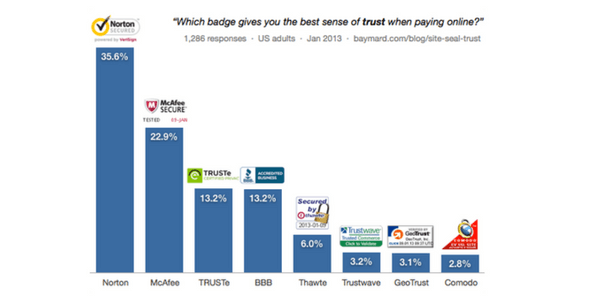
3. Show off your reviews and ratings
They influence your users, and Google knows it. Start asking for them as part of your after-sales process. You want to encourage reviews on all platforms that make up part of your buyer’s journey, including Google and Facebook.
Note: Google has been busy releasing product review updates, the first in April 2021 and the third in March 2022.
Essentially, Google wants to add more weight to more insightful reviews. In an e-commerce sense, you have a situation where you can lean on experts to leave reviews for your products but for more general reviews, you want to encourage and display reviews that provide in-depth product information and experience.
4. Have site search functionality
By allowing users to search your site, you make their experience infinitely better. Don’t make them spend more time than they need to when browsing through your product pages. You can also analyse their search terms to improve your keyword strategy.
For instance, is there a category page users search for that’s missing on your site?
5. Have information pages
Your customers will likely want to seek additional information that is not directly related to your product. For example, they may want to clarify your shipping times or returns policy. Or, they might have a general query about your business.
If you don’t satisfy their query right then and there, you risk losing the sale.
Treat your informational pages with the same care as your product pages—they directly impact the user experience. Beyond shipping and returns policies, informational pages include FAQs pages and information about your company. These pages can also contribute to how well you demonstrate E-A-T.
6. Have payment options
It’s helpful to communicate your payment options early, e.g. which credit cards, debit cards, or online billing services you accept. You don’t want to let your user reach the checkout page only to find out they can’t pay.
Allowing users to get this far in the checkout journey only to fail equals a bad user experience, and when they don’t come back, you can consider that bad for eCommerce SEO, too.
Further Reading: Looking for non-SEO tips to improve your eCommerce sales?
7. Have an HTML sitemap
E-commerce websites can contain a vast amount of content that is often confusing to navigate, despite your best efforts to organise your pages. To help users quickly find what they’re looking for, provide a user-facing HTML sitemap.
An HTML sitemap lists all the pages (or important parent pages) on your site in a clear, easy-to-read format. Your user can click on the link (page) they are looking for instead of getting lost in a website maze. The result? A good user experience, and a good SEO outcome.
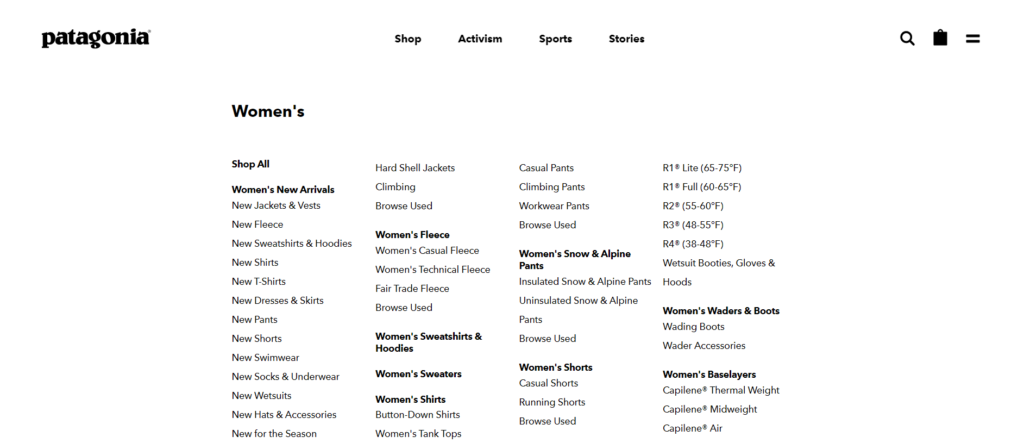
8. Ensure your pages have a maximum of three navigation clicks
Having pages that take more than three clicks to reach is not great for the user, and it’s also a poor indicator of that page’s search engine’s value. However, this 3-click rule may not apply to all websites, and the key takeaway is to make it easy for users to find the page they’re looking for.
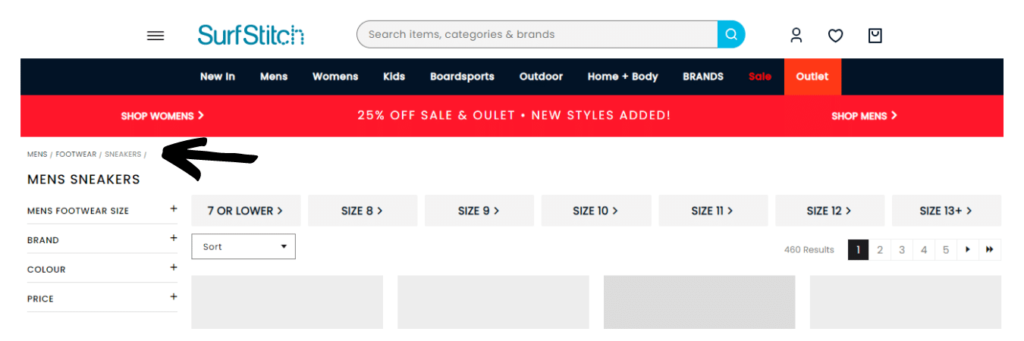
9. Have breadcrumbs
Breadcrumbs show the user a visual map of where they are on your site. Often, the breadcrumbs text path is visible on the top of a page or on the side, allowing for easy site navigation.
This is another great asset to improve your site’s navigation and user experience. They also help demonstrate to search engine show your site is structured.
Speed
I could categorise website speed as a single item under UX, but it’s so much more important these days and is worthy of its category. Slow websites kill conversions, and Google is openly encouraging webmasters to improve the speed of their sites.
Test your site with Google’s Page Speed Tool for desktop and mobile scores and tips. You can also use their Test Your Mobile Speed Tool to get a broader look at your mobile speed and how it compares to other shopping websites. This may be a worthwhile strategy for assessing your metrics and performance against your competitors.
Further Reading: Learn more about Website Load Time Statistics.
Here are some essential ways to slash your page loading speeds:
10. Enable GZip compression
By enabling GZip compression, you are compressing your web pages and style sheets before they are sent to the user’s browser. This process reduces the size of the files being transferred and makes your page load faster on the user end.
Test to see if you have GZip Compression enabled.
11. Use HTML, CSS, and Javascript minification
Minification is when the site code is cleaned and simplified to improve site speed by reducing load times and increasing bandwidth. (Bandwidth is the measurement of how much data your site can get to your users in X time.)
Often, site developers are generous with spacing in their coding to help them read and edit their work easiest. Believe it or not, unused (or even white) space within your HTML, CSS or Javascript can contribute to slowing down your page speed.
By minifying, you can compact your files and avoid sending unnecessary bytes to the server.
12. Keep third-party resources to a minimum
E-commerce managers love third-party solutions and scripts. But by the time you install pop-ups, social proof widgets, marketing automation, social widgets, YouTube videos, and remarketing tags, you’ve added a slew of extra scripts for the user’s browser to call.
Each of these scripts will contribute to slowing down your page speed, resulting in a poor user experience.
13. Lazy load your images
Images are the biggest contributing factor to slow websites, particularly e-commerce sites. One solution is to lazy load your images. Lazy loading enables images on long web pages to delay loading until the user scrolls to the part of the page where they’re located.
This means only needed images are sent to your user, which can be accomplished easily by tweaking website code or adding lazy image tags.
14. Resize your images
Too often, websites save or download images exceeding 1MB and 2,000px+. In fact, images don’t have to be this large to display well online. Forcing your users’ browser to resize these images when the page is rendering them increases the download time.
A quick fix is to resize and optimise your images for the web when you upload them.
15. Delete any images no longer required
Whether you have 50 products or 5,000, over time, you will have a bloated image library that will slow down your site. I encourage you to delete any image from your library when you don’t need it any longer.
16. Compress your images
You may not know it, but images often contain a lot of meta information (such as who took the photo and when). This information adds to the weight of the image and slows your web page download. Pro tip: Compress your images before uploading, too.
You can compress your images with tinyjpg.com.
If you want more tips on how to optimise your e-commerce images, check out these six suggestions from the Google Search Console team.
Images
As I’ve just noted, you should optimise your images to keep your website from lagging. However, remember that images are assets that can help you demonstrate what your page is about to search engines. Images also give you a chance to generate traffic from image searches.
Here are two ways you can use your images for SEO:
17. Use ALT tags
ALT tags are the traditional way of adding a description to an image. They help a search engine understand what it is about. Write in a clear, descriptive way that accurately depicts the image. Your ALT tag should be about 125 characters.
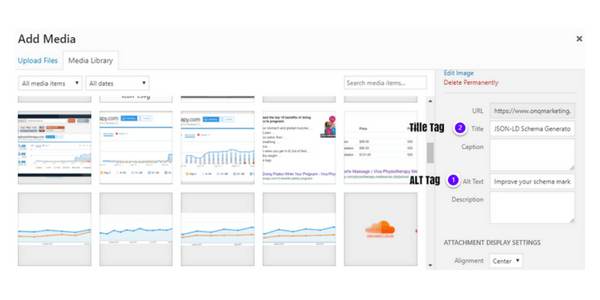
18. Use file names
Adding a descriptive file name is another indication of what the image is about, to help search engines. In general, keep your image file name to about five to six words.
Crawling and Indexing
Crawling and indexing comprise the more technical area of SEO. Nevertheless, it’s perhaps more important for e-commerce than most other verticals due to the complex architecture of these sites.
If search engine crawlers are not crawling your website adequately or efficiently, some, many, or all products may not be indexed.
Here are some solutions:
19. Check Google’s index
Enter “site:yoursite.com.au” into Google, and it will return each of your pages that it has in its index. There can be a few potential scenarios, but the one to be worried about is when it shows your home page only referencing the robots.txt file.
This result tells you that your site is blocking Google. Aside from that major issue, you also want to avoid Google indexing pages that are of little value to search engines or your users.
20. Check the Google Search Console and Bing Webmaster Tools
Your Google Search Console and Bing Webmaster Tools accounts contain troves of invaluable information. Check them on a regular basis for broken links, manual action penalties, HTML issues, etc.
These actionable faults or problems can improve your site and help you avoid ranking loss, for starters.
21. Have an XML sitemap
Create or generate an XML sitemap with your e-commerce platform and submit it with the Google Search Console and Bing Webmaster Tools. This sitemap differs from the HTML sitemap in Tip 7—the XML sitemap is generated for crawlers and Google, letting them know which pages on your site are important.
22. Be careful with product variations
You may have colour and size variations for your products. The structure of these variations can be critical to your SEO. So, you need to get this right. Sizes will, of course, be options on each product page if they’re relevant.
But if you sell shoes, what about colours? Do you have one product page with both size and colour as options? Or do you have separate product pages for each of the colours?
Having all the options on one page is good, but it may not be your best fit when you consider the user experience. On the other hand, if you have separate pages for each of the colours instead, you’re diluting your ability to rank for that product.
Which one should Google rank? You’re also going to run into duplicate content issues if you take the latter approach. In general, a specific color or size doesn’t need a separate page—the category page that contains the product variations will usually rank higher than a specific color or size.
23. Use canonical URLs
Take the example above where you might have separate pages for the different colours. Imagine that you have five different colours and five different pages. Compounding this issue is that this particular shoe falls under four different categories. Each colour would be on URLs such as:
- /category-1/colour-1
- /category-2/colour-1
- /category-3/colour-1
- /category-3/colour-1
This example would generate 20 different URLs for one product. It’s a mess!
To solve this problem, you need to implement canonical URLs. These tell search engines which URL you would prefer to use for each variation. Ideally, you want to get the unique identifying keywords closer to the root URL.
24. Use your robots.txt file
You should have a robots.txt file in place. To check yours, head to yoursite.com.au/robots.txt. The directives in this file tell web crawlers (including Google’s) what to crawl and what not to crawl.
The first thing you want to ensure is that you don’t see this:
Disallow: /
This directive tells search engines to avoid crawling your entire site.
Use the file to ask Google to ignore private and unnecessary folders within your site. You will be able to optimise your crawl budget by utilising the robots.txt file to manage the areas of your site that you don’t want Google to crawl.
In ecommerce you will traditionally want to ‘disallow’ the crawling of account pages such as /my-account/ and search results pages such as /?=.25. Redirect your discontinued products
If you have a product that is discontinued, you need to redirect the URL because that product URL is providing zero value to your user or Google.
But where will you redirect to? You could redirect to a relevant product URL, but what if that product is discontinued now or in the future? That will create a redirect chain. The best bet is to redirect to the appropriate category page instead.
WordPress User? The best 301 Redirects plugin I’ve used is “WP 301 Redirects” from the guys at WebFactory.
26. Noindex low-value pages and products
There are pages on your site that you want Google to crawl, but that you don’t need in search results. These should be “noindexed.”
Noindex this page, and start to refine the pages of your site that show up in Google’s index.
Category Pages
These pages are among your most powerful assets. They’re consistent and evergreen. Unlike products, your category pages don’t go in and out of stock, and they don’t get discontinued. They’ll continue to build your authority and acquire links for you.
Here are some tips for your category pages:
27. Use priority keywords
Do your keyword research. Your category pages should be targeting the broader, higher-volume keywords. After all, they’ll see more traffic and acquire more links over time, so they have a higher chance of ranking.
28. Have introductory content
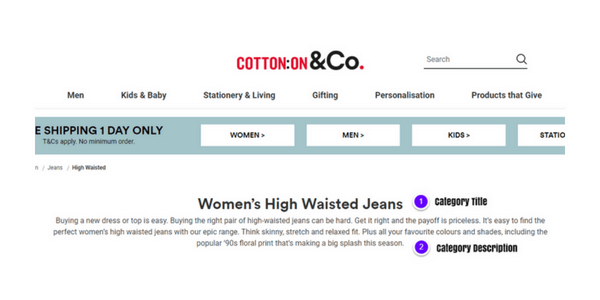
I often come across e-commerce pages that have product inventory on category pages with no supporting content. Treat these pages like the landing pages they should be. Add original content to describe the category, including unique page copy.
It’s also a great spot to highlight any specific sales and to link to specific informational content.
29. Add pagination if necessary
Dealing with pagination is another critical SEO consideration. Traditionally, you’ll see about 20 products on one category page. If you have more than 20 products on one page, you have a decision to make.
i. Serve them all
The downside is that you risk slowing the loading speed of that vital page.
ii. Implement infinite scroll
Facebook uses this scrolling technique in its news feed. The downside is that Javascript is used to activate the infinite scroll, and Google may not crawl the products below the Javascript fold.
iii. Add pagination
This allows your users to click to different pages, i.e. /page-1/, /page-2/, etc.
But you don’t want multiple versions of your category pages being indexed and displayed in search results. However, you can add markup (rel=prev and rel=next) to sort that issue out.
UPDATE: Google has now told the SEO community that the company realised it hadn’t been using rel=next and rel=prev for indexing in years. This means the rel= markup is not necessary, but make sure that the pages are linked.
Read more on SearchEngineJournal.
30. Use filters
I’ve already touched on sizes and colours as product options, and these might be filters from your category pages or your main shopping page. Additional filters will filter products by price and more, creating numerous variations that can get messy from a product URL perspective.
Controlling this situation requires a skillful blend of noindex tags and robots.txt file directives.
Product Pages
While they may not be the landing page asset that categories can become, product pages are still essential to an optimised e-commerce site (and not just for their ability and role in converting customers).
Let’s review some tips for your product pages:
31. Promote related products
Keeping your user on your site until they convert is your ultimate goal. Displaying relevant and valuable related products is a great way to do this. It’s excellent for UX, and it also gets visitors browsing around your site and demonstrates the value of your other products.
32. Use video
A video is engaging and offers a rich experience. Videos keep users on your site for longer and deliver important messages faster. A video adds to the user experience and, in turn, demonstrates value to search engines.
33. Have great product images
Buying something online comes with risks. This risk can manifest as anxiety when a customer wants to get a better idea about the product in question. Images can help quell your customer’s reluctance and reassure them that the right decision is to buy your product.
34. Use unique descriptions
One of the most common SEO issues with e-commerce is the copy and paste job of product information from the manufacturer’s website. Not only are these descriptions typically uninspiring, but they’re also the same copy that many competitors use.
Seriously, if you’re guilty of this type of copy and paste approach, copy a snippet of your product description and put it into Google search. You’ll see just how many of your competitors have done the same. A unique and compelling product description is one of the easiest ways of distinguishing yourself from your competition.
General On-Page Optimisation
Of course, there are on-page optimisation factors that are important whether you manage an e-commerce site or not. They help communicate what your page is about to Google and your users.
Take a look at some on-page optimisation techniques:
35. Use unique page titles
Your page title is an excellent indicator of what readers and search engines can expect from a page. You should include your target keyword in there. Keep in mind though, that if it’s not unique, then Google won’t necessarily know which page to rank for that target keyword. If it gets it wrong, what will that cost you?
36. Have unique meta descriptions
The first touchpoint you have with your potential customer is often via search results. These results will likely be a page title and a two-line description pulling from your meta description of it.
Create a unique, informative, and appealing meta description. More clicks indicate that you’re providing value and will be great for your SEO. The rule of thumb for meta description length is between 145 to 155 characters.
37. Use internal linking
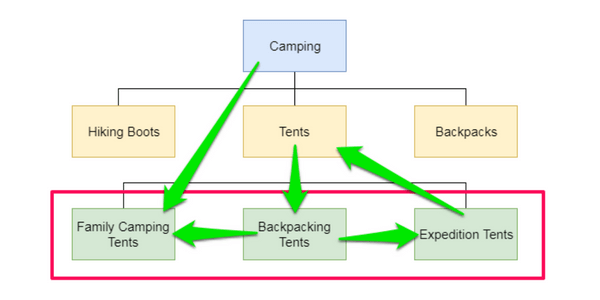
When Google and other search engines crawl a website, they don’t browse it as humans do. Imagine your site as a sitemap with a hierarchical structure. Ideally, you want to link from your home page (the top of the hierarchy) to your category pages (mid-level). Then from your category pages to your product pages (lower level).
Internal linking can be one of the easiest ways of boosting SEO on poor-performing pages.
38. Optimise permalinks/URLs
There are a few things you need to be mindful of with your URLs. When you’re adding your slug, be descriptive and use your target keyword. Keep it short, don’t use underscores, and remove words like ‘and’, ‘if’, ‘to’, etc.
For example, let’s consider a category page with the keyword blue and white camping tents.
This is an example of a poor URL.
- campingsite.com/blue_and_white_tent_for_camping_and_hiking_in_wilderness
This is a more concise, yet equally descriptive URL.
- campingsite.com/blue-white-camping-tent
Or if you have different categories of tents.
- campingsite.com/hiking/blue-white-camping-tent
Extras
While I call these “extras,” these tactics are no less critical to your e-commerce SEO strategy than the ones we’ve studied. I call them extras because they don’t naturally fall into one of the earlier categories. If you follow these specific tips, you’ll increase your domain authority and branded searches, improve your keyword targeting, and score yourself compelling rich snippets in Google.
39. Conversion tracking
As an e-commerce manager, you should track both your conversions and your assisted conversions. Not only is conversion tracking essential in identifying the value of your campaigns, but it can also provide you with valuable information for your keyword targeting.
Subtle differences in search queries can change the quality of your search visitor’s experience or their readiness to purchase.
40. Use Schema Markup
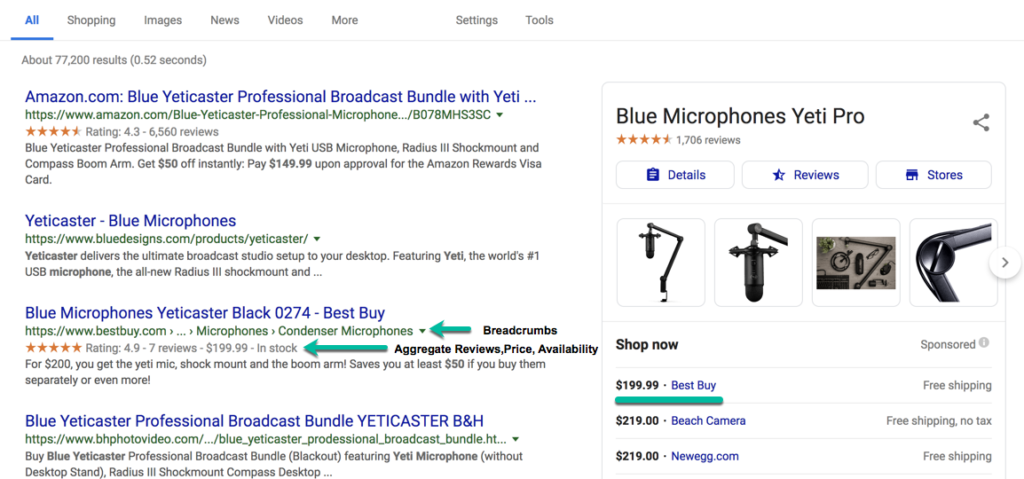
Schema is a markup language that enables you to add another layer of structured content to your pages. This markup will also help communicate your page content and intent to all the major search engines.
Source: SEMRush.com
The direct result of implementing Schema markup may include rich snippets in Google’s SERPs (search engine results pages). For an e-commerce site, these snippets can be stock availability, price, product rating, and more. Schema markup is also a recommended tactic to score valuable voice search results.
Here are some more tips from Google:
41. Encourage link building
Link building is still considered a reliable indicator for search engines. Best practice is to source a healthy blend of high-quality, contextual, and (where appropriate) local links to your site.
The Power of PR: Public Relations firms can help you gain brand exposure, which increases branded searches and strengthens your online authority. Their work will also help you secure strong editorial placements linking back to your website.
42. Encourage social media engagement
Is social media engagement a ranking factor? Google has stated that it’s not. Still, managing and maintaining an active social media community improves your SEO by earning you links and increasing branded searches.
43. Aim to obtain shopping comparison listings
While they could be considered link building (albeit low value), there is one crucial distinction; these shopping comparison sites can be great referrers of traffic and sales. Do your research into what comparison sites your competitors are listed on and try them yourself.
44. Offer university discounts to generate high-value links
Links from .gov and .edu websites have long been considered high-value targets because they’re so much harder to acquire than other link types. The good news is that it isn’t that hard for an e-commerce website to acquire educational links.
For example, try reaching out to universities and offering an exclusive discount for their students. All they have to do is promote the offer on their university website with a link to your site—ideally to a landing page that you’ve created specifically for that university.
45. Write blog posts around your priority products
Blogging has been one of the prominent inbound marketing tactics of recent times, but for e-commerce sites, it’s still not a mainstay.
It does have a deserved place though. The caveat is that if you haven’t invested in your product copy or the copy across your informational pages, then blogging may be moot. Prioritise your informational copy first.
Once you’ve done that, consider funneling more resources into blog posts. You might start by identifying your priority products. Is your audience researching those products? Are they searching for information that isn’t typically found on the same site that sells the product? If so, then there’s a significant blogging opportunity.
Create a streamlined experience for your user. Be the general source of information about the product and then offer it to them via your site. It sounds simple, but in many customer journeys, the research to purchase experience is disjointed.
“BONUS: Utilise Google’s Free Shopping Listings
Google has launched free shopping listings with its Surfaces Across Google program. If you’ve been advertising with Google Shopping via Google’s Merchant Centre, then you don’t have to do anything.
If you haven’t been advertising, then you’ll need to set up a Merchant Centre Account. It’s all straightforward until you need to add your products or product feed. However, if you’re using Shopify, they’ve made it extremely easy—you’ll find what you need to know here.